 Greg Marshall

A lot of the GoHighLevel accounts I get asked to look at are half built. A pipeline went in, a few sequences, a booking calendar, and then somewhere around the middle questions nobody had answered started turning up. Now the team works around the system rather than in it.
You wouldn’t build a house without drawing it first, but most GoHighLevel systems get built exactly that way. This article covers how to do the design on paper before anyone touches the software, so what you hand over is a proper brief rather than a wish.
Why do so many GoHighLevel builds stall halfway?
They stall because the thinking still has to happen, and if it doesn’t happen before the build it happens during it, at build rates. Every question you haven’t answered becomes a decision someone else makes for you, usually the quickest one available.
Then you find out what’s wrong once it’s live and your staff have already started working around it. Answer the same questions in a document first and a change costs a minute on a page instead of a fortnight in a live system. A quoting delay that costs nothing to find in a planning document means rebuilding the middle of the system if you find it three months into a build.
What does a leaky enquiry process look like in numbers?
In the example business I use in the video, more than half of all enquiries never get as far as a quote. Halstead Heating is a made-up plumbing and heating firm, but it’s put together from the kind of businesses I go through every week: 14 staff, around £1.8 million a year, and six different ways an enquiry can arrive, one of which is an engineer’s mobile and a receipt book in the van.
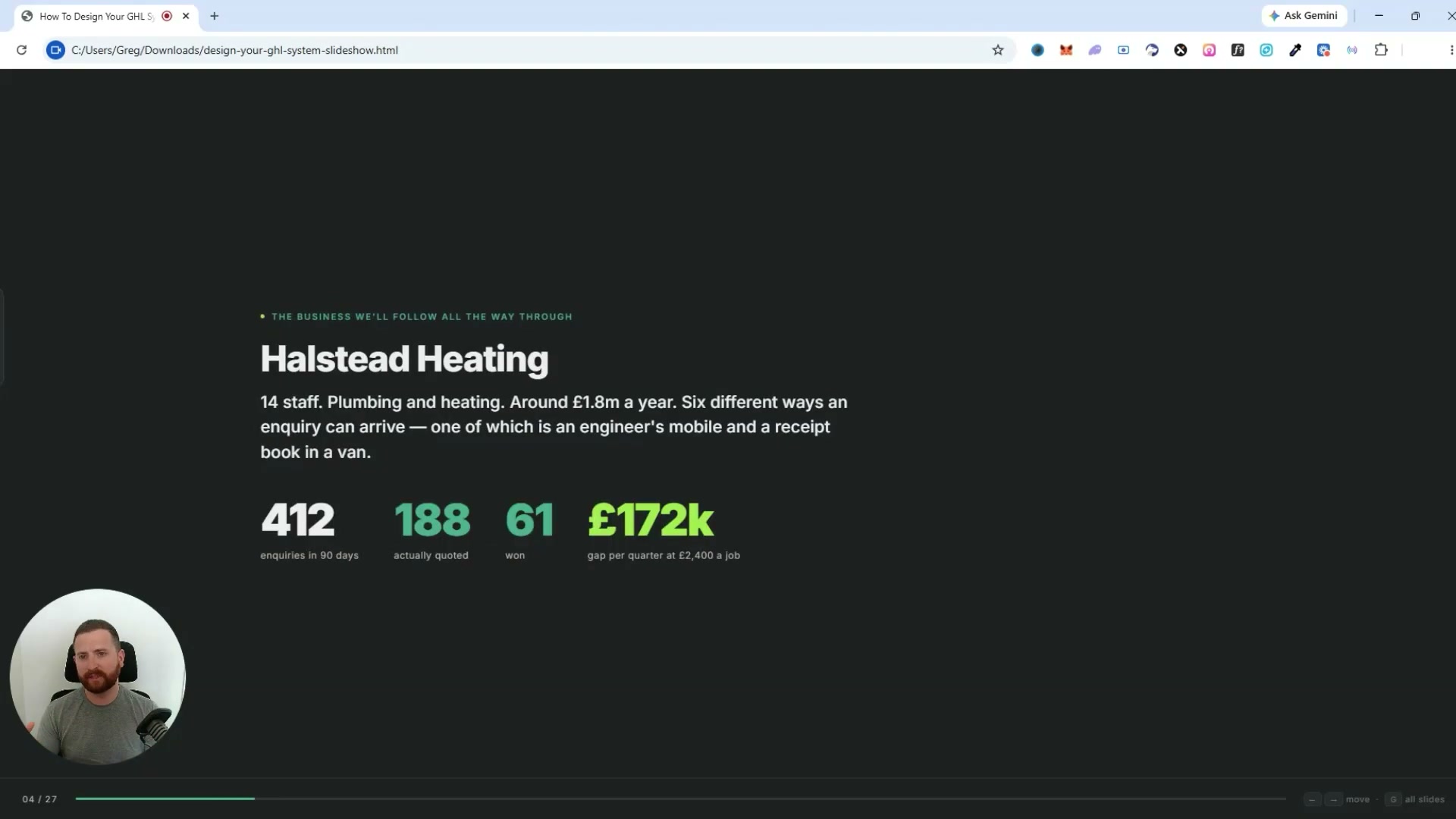
In 90 days Halstead gets 412 enquiries. 188 of them get a quote, about 46%, and 61 are won at around £2,400 a job. If the 224 enquiries that never got a quote had converted at the same rate as the ones that did, that’s roughly £172,000 a quarter the business isn’t seeing.
None of that is a lead problem. The enquiries are already coming in. It’s what happens after they arrive that’s leaking.
How do you plan a GoHighLevel system without touching GoHighLevel?
You do it in four phases: map what actually happens now, describe the ideal in plain English, try to break it, then hand it over as a brief. Each phase has a test for knowing you’re finished, and the output is one document of eight or nine pages written in an ordinary word processor. No flowchart software, nothing to buy.
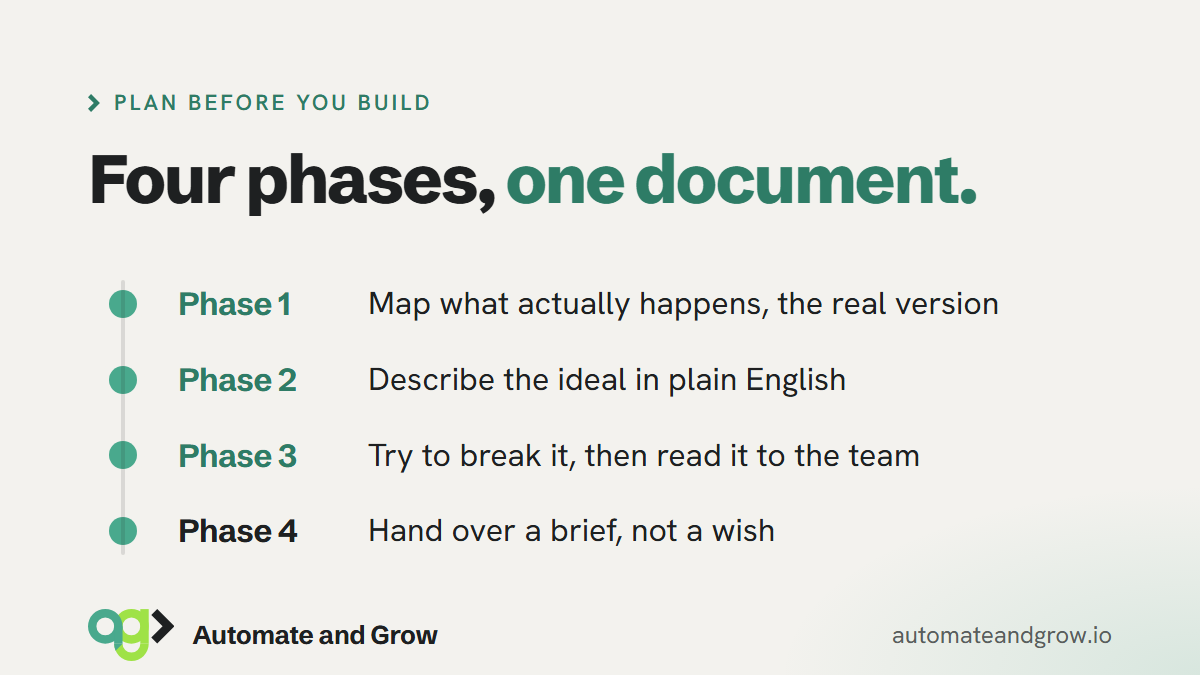
For Halstead it took the owner, Mark, roughly four hours spread over a week, and most of that was him talking. Someone experienced can run the interviews and write the brief, but nobody else can supply the answers, because the way your business actually runs only exists in your head and your team’s.
How do you map what actually happens now?
Pick one real enquiry from last week, talk it through out loud and record it. Don’t type it. People are far more honest describing a process out loud than writing it down, and what you want is the real version, not the tidy one where everything comes through the website form and nobody answers their mobile in a van.
Go through it three times:
- The happy path. From the enquiry arriving to the money landing, as if nothing went wrong.
- The exceptions. Where it stalls, who chases what, what happens when someone enquires at 11pm or on a Saturday morning.
- The handoffs. Who has it, who they pass it to, and what each person’s job is at that point.
Only then describe the business itself: what you sell in the words your customers use, who buys it, roughly how many enquiries a quarter and what a job is worth. That goes last on purpose. Start with it and you’ll describe the business the way your website does, then describe the process to match.
Mark’s recording had this in it, about weekends:
Phone diverts to the answerphone after 6. I don’t know if Dave picks them up. I’m honestly not sure what happens to those.
That’s what the recording is for. Give the transcript to an AI (I use Claude) and ask it for the process in order, every gap, and the questions you need to ask your staff. For Halstead it flagged what happens to enquiries after 6pm and at weekends, whether the five routes that aren’t the office line ever reach the spreadsheet, and a contradiction: “nobody chases” and “Karen might if she remembers” both appeared in the same recording.
The test for this phase is that someone who doesn’t work there could follow the map end to end.
Can AI design the GoHighLevel system for you?
No. AI is a good interviewer and a good editor, but not a great architect. Ask it to design your GoHighLevel system and you get a generic best practice setup for a business that doesn’t exist, confident, tidy and wrong about yours.
It also only knows what you tell it. Left to tidy up Mark’s recording, an ordinary AI would have happily written “weekend enquiries are handled by the on-call engineer”, and it would have sounded completely plausible. That’s why phase one starts with you talking and phase three brings in other people. The AI never gets to be the only reviewer.
How do you describe the ideal without designing the software?
Write how it should go in plain English, describing outcomes rather than mechanisms, so that it doesn’t assume any particular software exists. What most people write instead is a feature list. They’ve seen that you can set up a missed call text back, so a missed call text back goes in. That’s shopping, not designing.
Here is part of Mark’s ideal:
An enquiry lands at 9 at night. Within 2 minutes they get a reply telling them when someone will call and what we’ll need to know. If they don’t answer, they get one more message at 8 in the morning, and Sarah sees it on her list at 9.
The thing to watch for is mechanism creep. Mark’s first draft said that if a customer hadn’t replied to a quote “the system tags them and moves them into the follow-up pipeline”. That’s software talk. The outcome is “if we haven’t heard back in 3 days, someone gets in touch again”. It matters because if you hand the builder a mechanism, that’s what you’ll get, and a tag might not be the best way to do it at all.
Also watch for old problems carried straight across. Mark’s ideal still had Karen typing quotes up on a Friday, which puts up to 11 days between the visit and the customer seeing a price. He’d fixed the first 2 minutes of his process and left that sitting in the middle, because it had been there so long it had stopped looking like a problem.
You’re done with this phase when you could read it aloud to a 14-year-old, and every exception from phase one has an answer.
How do you find the holes before anyone builds it?
Try to break the design on purpose, then read it out loud to the people who’ll use it. The first draft is always a fantasy of a good Monday.
Run it against three bad days:
- The busy Monday. 40 weekend enquiries waiting and two engineers off sick.
- Someone’s on holiday. The owner of each step is away for a fortnight. Does their work wait, move or disappear?
- The late reply. A lead goes quiet and answers six weeks later.
An AI told to play a sceptical operations manager who has watched two previous systems fail is quite good at this. For Halstead it found that the 8am message and the 9am list both assumed Sarah was at her desk, that nobody covered Sarah or Karen when they were away, and that after six weeks nothing said whether a quote still stood.
What it missed entirely was emergencies, because nothing Mark wrote said some jobs are urgent. That came from one of the engineers:
Half of our weekend calls are no heat or a leak. If they wait till the next morning to hear from us, they’ve already rung someone else.
Mark was looking at the process from the office, and the people out doing the work often understand it better. So read the design to the team, in a room, in one sitting. Don’t email it round, you’ll get silence or “looks good”. Their objections go into the document even where you disagree, because a design your team has argued with is one they’ll actually use.
What should the brief you hand over include?
The brief is the one document the builder works from, and for Halstead it ran to eight or nine pages in six parts:
- The as-is map
- Two narratives, one enquiry that goes well and one that goes wrong
- A decision log
- Non-negotiables
- What’s out of scope for version one
- The 90-day numbers
The decision log is where calls like this get written down: Dave’s mobile stays, because twenty years of repeat customers ring it, so the design brings those calls into the system rather than switching the route off.
The 90-day numbers give the build something to be measured against. For Halstead the targets are enquiries reaching a quote going from 46% to 65%, and the gap between site visit and quote going from up to 11 days to under 48 hours. Those are targets, not results, and you set them before anyone is paid to build. The test for the brief is that someone technical could quote for the build without ringing you.
Where should you start this week?
Pick one real enquiry from last week and record yourself talking it through, the happy path, the exceptions, then every handoff. It will almost certainly turn up at least one step you’re not sure actually happens, so ask the person who handles it what really goes on.
If GoHighLevel is already half built in your business, look at what’s there first. You can run your workflows through an AI audit yourself in an afternoon, or book the free audit below and I’ll go through the account against how you actually sell.
When not to bother. If it’s you and one other person and you both know the whole process, you don’t need eight pages, a page of notes will do. This method assumes several people are involved in getting an enquiry to paid, because that’s what makes a design worth writing down. And if you haven’t yet decided between a snapshot and building from scratch, the seven decisions to make before you set GoHighLevel up come first.