 Greg Marshall
Think about the enquiries you have lost over the years simply because they fell through the cracks. The visit that was booked and never happened. The quote that went out and went quiet. The person who said “not right now” and was never spoken to again.
None of those were lost at the start. Most businesses are quick on a new enquiry. The first text goes out in minutes, the booking link is in the first email, someone rings back the same day. Then the lead gets a week or two into the pipeline and the process stops. What happens next relies on someone remembering.
That is the leak this article is about. Not speed to lead. What you send after week two.
Where do leads go missing after the first two weeks?
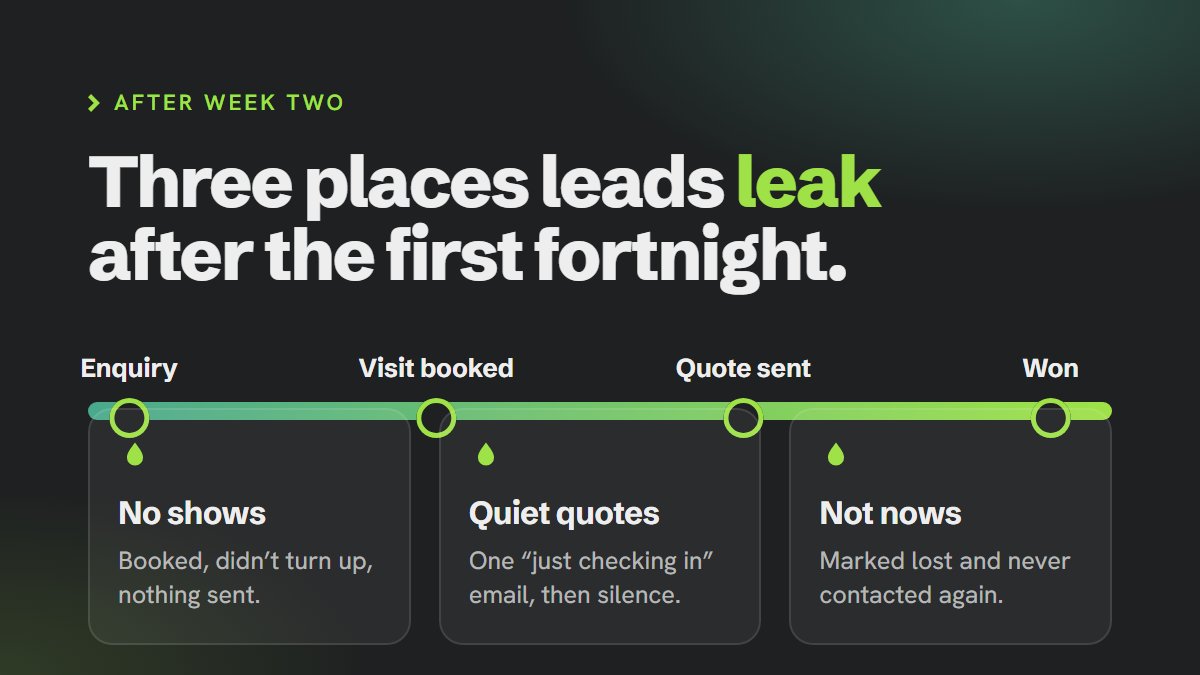
Between visit booked and won, in three places: bookings that do not turn up, quotes that go quiet, and people who said not now. Picture your pipeline from enquiry, to visit booked, to quote sent, to won. Nearly all the automation sits at the front. Nearly all the money sits at the back.
Three kinds of lead drop out between visit booked and won:
- No-shows. They booked a call, a survey or a site visit and did not turn up.
- Quiet quotes. You sent a price. They went away to think about it. A week later you have heard nothing.
- Not-nows. They told you the timing was wrong. Nobody has spoken to them since.
Each of these has already cost you real money. You paid to generate the enquiry, someone spent time qualifying it, and in two of the three cases you have done a visit and written a quote. Letting them go quietly is the most expensive thing your system does, and it does not show up anywhere in your reporting. It just looks like a quiet month.
What should you send after a no-show?
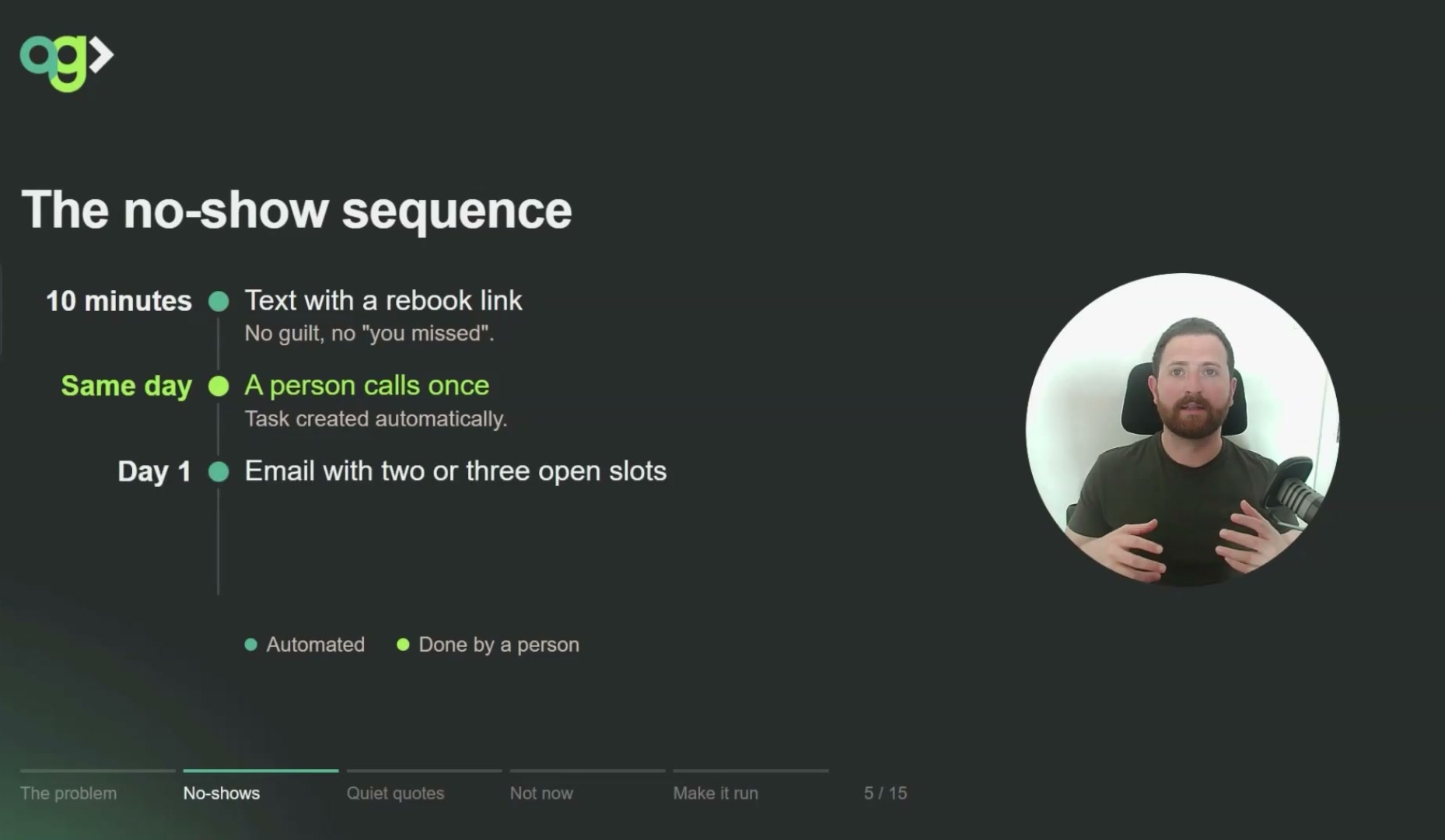
A text with no guilt in it within ten minutes, a call from a named person the same day, and an email offering two specific slots. Done properly, that brings back three to five of every ten no-shows.
What usually happens instead: nothing. The appointment sits in the calendar as a gap and nobody sends a thing.
What sometimes happens is worse. A message goes out saying “You missed your appointment.” That makes the customer feel they have done something wrong. Embarrassed people do not rebook with you. They ring someone else.
A no-show is not a no. They forgot, or something came up at the last minute, or the school rang. Treat it that way and a good share of them come back.
What to send:
- Ten minutes after the slot. A text with no guilt in it and a link to pick a new time. “Looks like we missed each other today. No problem at all. Here is a link to grab another slot, or just reply with a day that suits.”
- Same day. A task lands with a named person to ring them. Not a note in a group chat. A task, with a name on it.
- Same day, by email. Offer two specific slots. “Can you do Tuesday at four, or Thursday at six?” People answer a yes-or-no question far more often than an open one. “When works for you?” needs thinking about, so it does not get a reply.
- Day three. One more text, same tone.
- After that. They drop into the long-term nurture described below, rather than vanishing.
For every ten bookings that do not turn up, that cadence will usually bring three, four or five of them back. For a business doing site visits, that is three to five quotes a month you were already paying for and not getting.
What should you send when a quote goes quiet?
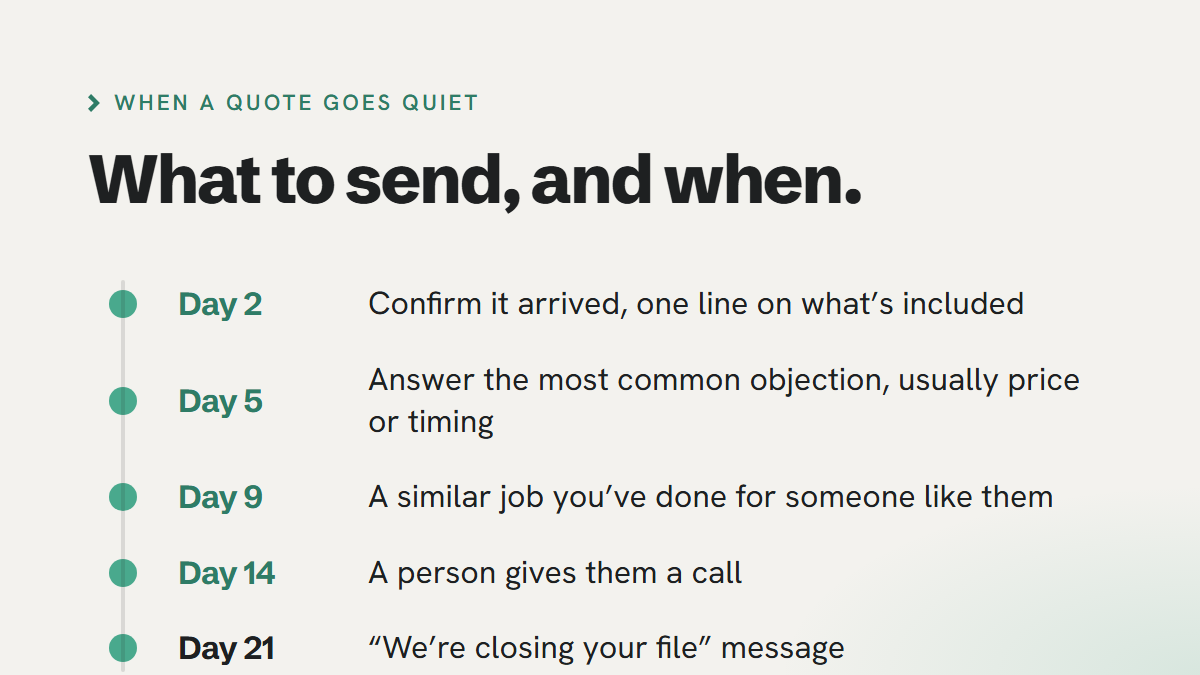
Five touches over three weeks, each giving the customer something to do: confirm it arrived, answer the objection they have not raised yet, show a similar job, have a person ring, then close the file. One “just checking in” email is not a process.
This is the most valuable lead of the three. A visit and a quote have already been paid for in your time. There is nothing left to do except get an answer.
What usually happens: one “just checking in” email, then silence. That email asks for a decision and gives the customer no reason to make one. When they do not reply, the owner decides the price was too high and moves on.
Often the price was fine. They were comparing. They had a question they did not ask on the visit. They got busy. None of those are a no, and none of them get resolved by checking in.
What to send, and when:
- Day two. Confirm the quote arrived and give a one-line summary of what is included. Short, factual, easy to reply to.
- Day five. Answer the most common objection before they raise it. For most trades that is price or timing. “Most people who get a quote from us ask the same two things. Can it be done in stages, and can the cost be spread? It can.”
- Day nine. Show a similar job. A photo and two lines about a customer like them.
- Day fourteen. A person rings. If you want a second call, day seven and day fourteen.
- Day twenty-one. A closing message. “We are tidying up our quotes for the month. If this one is still live, let me know and I will hold the price.”
The rule across all five: every message gives them something to do. A summary to read, an answer to a question, a photo to look at, a way out. None of them only ask.
How do you follow up a lead who said “not now”?
Stay remembered for twelve months: one useful email a month, a personal check-in each quarter, and a call from a person at three and six months, always with one step they can take. “Not now” does not mean no. It means not now.
A new kitchen can be a year-long decision. A heating system gets replaced when the old one finally dies. For anything high-ticket the gap between first enquiry and purchase can run to months, and most businesses only have a process for the first two weeks of it. The lead gets marked lost, or abandoned, or simply forgotten.
Then, when the customer is ready, they ring whoever they remember.
Twelve months of staying remembered:
- Monthly. One useful email. A finished job, a tip, a price guide, the answer to a common question. Useful, not promotional.
- Quarterly. A personal check-in from a named person. Two lines, written like a human.
- At three and six months. A task fires to a person to ring them and ask where their thinking has got to.
- Always. A step they can take. Reply with one word for a revised quote. Click to book a ten-minute call. A reason to come back that does not need them to re-explain themselves.
Do this for every not-now and you lose fewer of them to whoever happened to be top of mind on the day.
How do you make late follow-up run without anyone remembering?
Start each sequence when the pipeline stage changes, stop it the moment the customer replies, and send a task to one named owner. Everything above can be done by hand, and that is exactly why it does not happen. Early follow-up gets automated because it is obvious. Late follow-up gets handed to a person, and when that person has thirty leads floating around at different stages, the ones from three weeks ago are the ones that slip.
The fix is a design decision, not a software one, the same kind as the decisions that need making before you set GoHighLevel up:
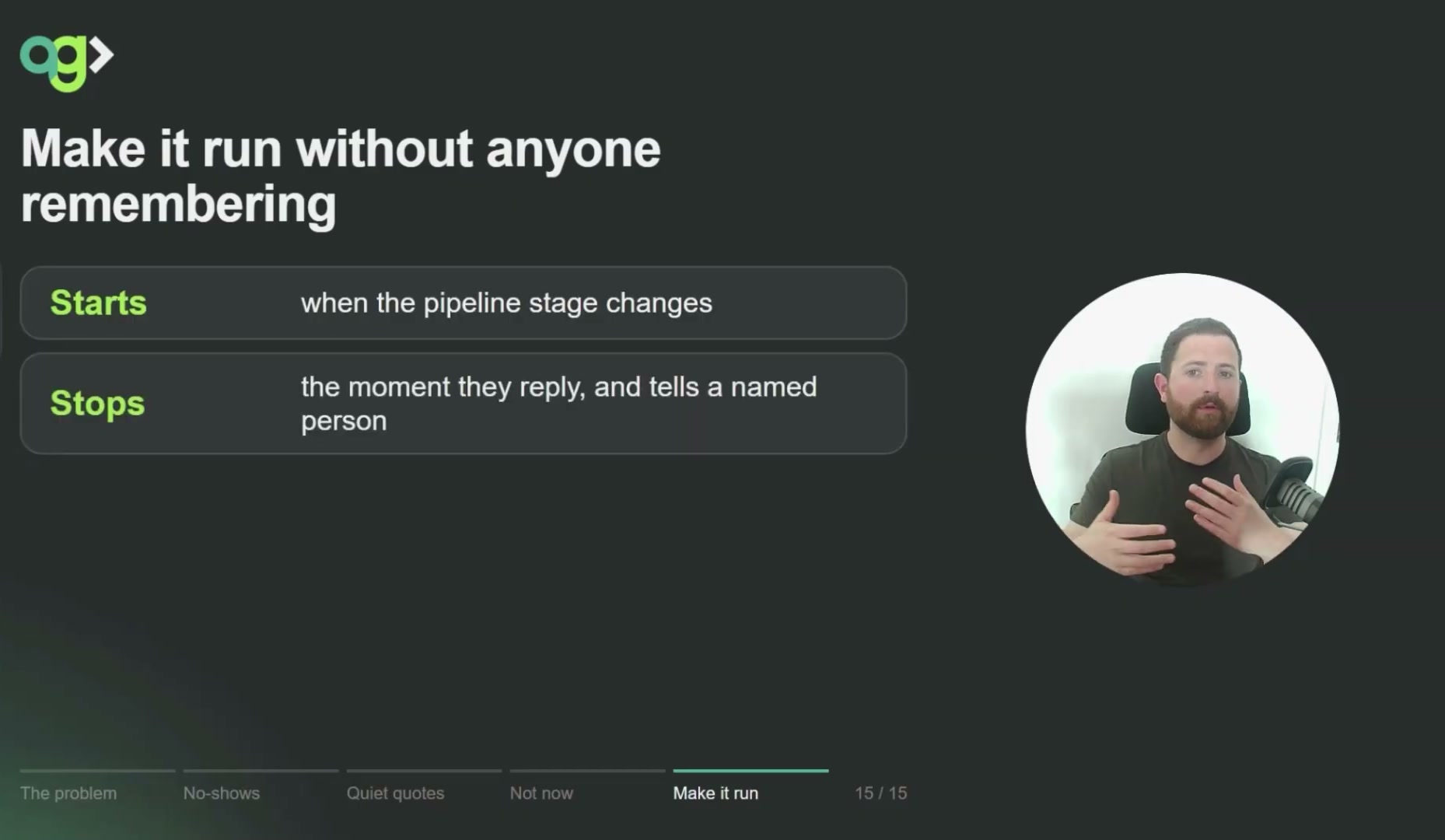
- The sequence starts when the pipeline stage changes. Visit booked becomes no-show, the no-show cadence starts. Quote sent sits for two days without a reply, the quote cadence starts. Nobody has to press anything.
- It stops the moment they reply. The whole point is to get a response. The second one arrives, the automation stops and a task goes to a named person with a notification, so the conversation picks up where it left off.
- Somebody owns it. Not “the team deals with leads”. One person whose weekly list includes these follow-ups, who gets the task and knows it is theirs.
The handover is the bit most systems miss. It is easy to build a sequence. It is harder to decide, in writing, who gets the task when a lead replies, and what they do with it. If that is not decided, the automation just generates messages nobody acts on.
Where should you start this week?
Test your own system, then fix the quiet-quote stage first. If you only do one thing, send yourself a test. Book a visit through your own system, do not turn up, and see what arrives. Then send yourself a quote and go quiet. Most owners are surprised by how little happens. If you would rather see every sequence at once than test them one at a time, exporting your workflows and running them through an AI audit shows each one that ends early in a single pass.
Then pick the leak that is costing you most. For most service businesses that is the quiet quote, because it is the lead you have already spent the most on. Build the five-touch cadence above for that one stage, give the task to a named person, and leave the other two until it is running.
If your system does none of this, it is not broken. It is just unfinished. You almost certainly do not have a lead problem. You have a leak problem, and the leaks are in weeks two to twelve.